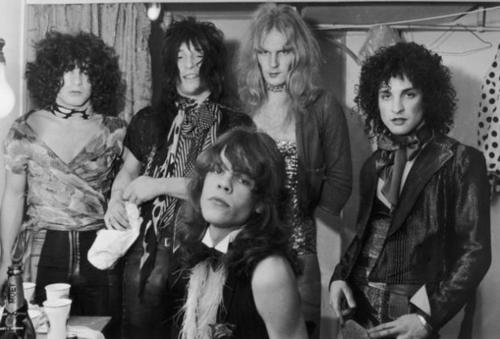
When a band is in its earliest days, it’s always the hardest part. Some members can’t hack it and quit the rock and roll lifestyle, while others get too deeply entrenched in it. This is something most, if not all, bands come across. On the odd occasion, the lifestyle gets the best of them, and difficult decisions have to be made. Unfortunately, this is one of those stories. This Week, the Beat Marches On to 6th November 1973, when the New York Dolls drummer Billy Murcia dies.
The New York Dolls were an inspiration to the punk movement that was to come. They didn’t know it at the time, however, and they certainly didn’t look like they were punks. Inspired by the glam rock of David Bowie and T-Rex, they dressed up like their idols, wearing make-up and high heels on stage and became an influence on the sunset strip in LA, a decade later.
The band formed in 1971, with David Johansen on vocals, Johnny Thunders and Sylvain Sylvain on guitars, Arthur Kane on bass, and Billy Murcia on drums. They were from New York (a very different New York from the one we know now) and gradually built momentum in the city.
Due to their unique look, they had a big following in the LGBT community, although they weren’t themselves and wouldn’t hesitate to beat you up if you accused them of it. They had a weekly residence at the Mercer Arts Center to a modest crowd of 350 people.
They signed a management contract with Marty Thau and Steve Leber. They decided to send the band to the UK as they thought it would be easier to break the band there than in the US, as many places were still quite conservative and wasn’t ready for them.
One of the Dolls’ first gigs in the UK was at Wembley Arena in support of Rod Stewart and the Faces. This was a band that didn’t have a record deal or even a single, now performing in front of 13,000 fans. They played a few headlining gigs at smaller places such as Dagenham Roundhouse and Malcom’s Discotheque in Kingston-Upon-Hull, and they were the support act for Status Quo at Imperial College, London. This would be Murcia’s last gig with the band.
Billy Murcia wasn’t supposed to go to the party that night. He asked Thau for five pounds and was just going to stay at the hotel. As the two were talking, the drummer received a phone call, and just like that, the party was on. Little did he or the band know that this was his last ever party.
The party was held in a flat in Kensington, London. The socialites and the hipsters in the scene were in attendance, and the drinks were flowing. Then came the hard stuff. Cannabis, Quaaludes, and there were even rumours of heroin.
After having a few drinks with the crowd and taking some Quaaludes or ‘Mandy’s’ as they were known and often confused with Mandrax (a similar type of drug) Murcia passed out, some reports say in the bathroom, but it’s unclear where he collapsed, but eventually ended up in the bathroom, where the party goers tried to wake him up.
Instead of calling for an ambulance, which is what they should have done, the ones who didn’t scarper decided to draw an ice-cold bath to shock Murcia awake, an old wives’ tale about reviving overdoses. This didn’t work as, rather than overdosing, he was choking. They then decided to pour hot black coffee down his throat to wake him up, which didn’t work either. It was too late, Billy had died aged just 21.
Thau got a phone call while in discussions for a record deal with Tony Secunda. He left as soon as he got the news, but by the time he got there, all he could do was identify the body. To stop the tabloids from sniffing around the band, he sent them back to New York on the next flight. Only he and Leber stayed to answer questions from the police.
This posed a difficult question for the band when they arrived back home: do they carry on or call it quits? Murcia was the founding member of the band along with Sylvain. They were childhood friends bonded by growing up as immigrants, as Murcia was born in Colombia and Sylvain was born in Egypt. He had to notify the family of the tragic news.
The band couldn’t take their time with the decision as the momentum they built while in the UK was slowly declining. They had no time to mourn the death of their friend, a troupe that bands have been dealing with since the rock and roll days of the 1950s.
The band decided to carry on. Bringing in Jerry Nolan as the new drummer. Before the year ended, they got a record deal with Mercury Records. By 1976, the band had broken up. They reformed in 2004 with the remaining members Johansen and Sylvain. They lasted longer than their original spell until 2011.
The Beat Marches On is a music blog written by Jimmy Whitehead. Jimmy has been blogging for nine years, specialising in Sports (especially American Football). If you want to follow Jimmy on Twitter: @Jimmy_W1987
The Beat Marches On has a Facebook page: https://www.facebook.com/The-Beat-Goes-On-Blog-107727714415791 and an X page: @TheBeatGoesOnB1
Websites used for research were:
The tragic death of the New York Dolls’ drummer Billy Murcia
The book Please Kill Me: The Uncensored Oral History of Punk by Legs McNeil and Gillian McCain was also used.
If you want to request a story for The Beat Marches On blog, you can contact jwhiteheadjournalism@gmail.com. We cannot guarantee that the story will be published, but it will be considered.